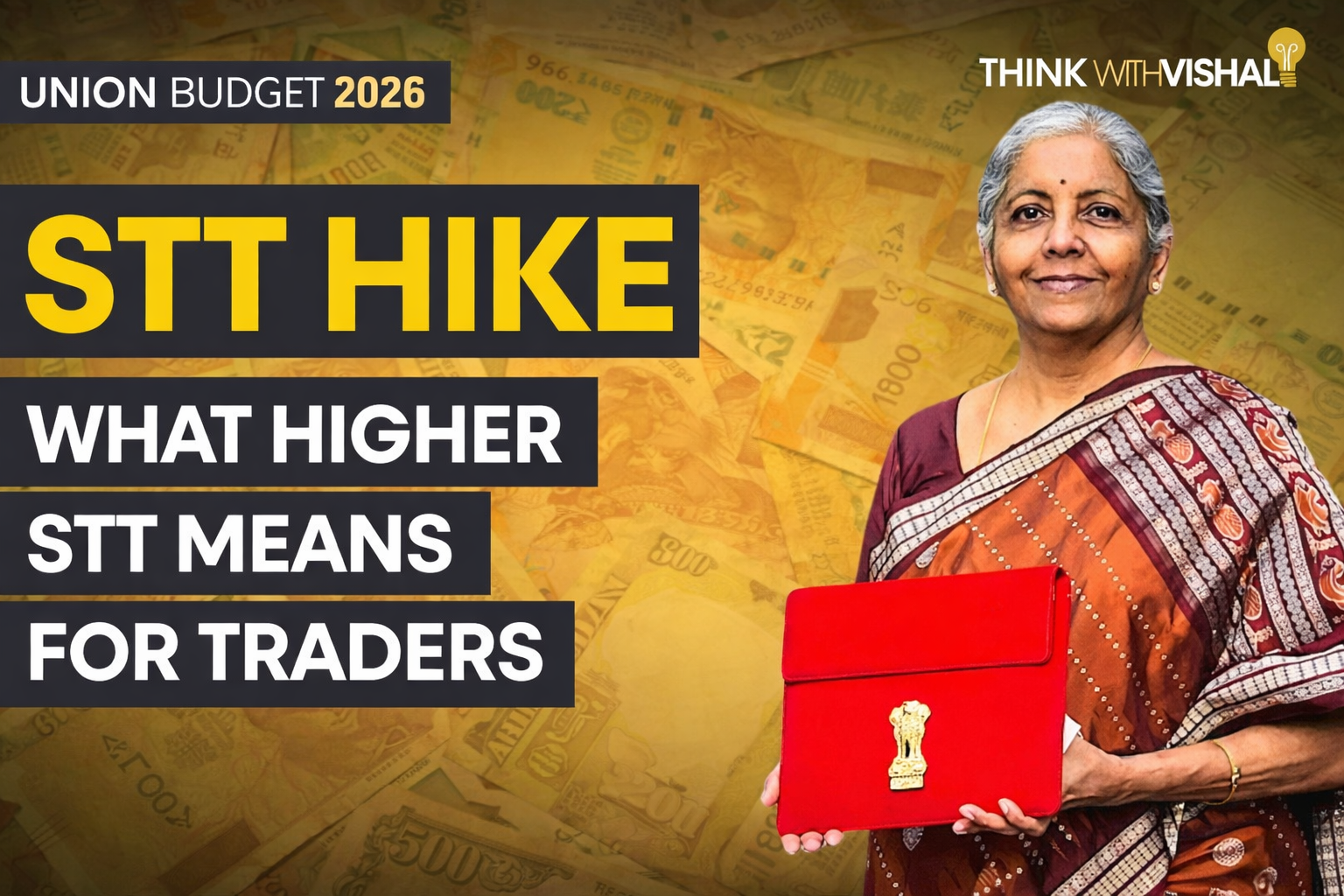
Union Budget 2026–27 has introduced several structural reforms aimed at simplifying India’s tax system and improving compliance. Among these, one announcement has caught the immediate attention of stock market participants — an increase in Securities Transaction Tax (STT) on Futures and Options (F&O) trading.
Presented by Finance Minister Nirmala Sitharaman, the Budget reflects the government’s intent to balance market growth with disciplined participation. For traders, this change directly affects profitability and strategy, making it essential to understand what STT is, what has changed, and how it impacts different market participants.
What is STT (Securities Transaction Tax)?
STT is a tax levied on the purchase or sale of securities executed through a recognized stock exchange in India. It is charged automatically at the time of transaction and collected by the exchange on behalf of the government. STT applies to equity delivery trades, intraday equity trades, futures contracts and options contracts.
In simple terms, every trade attracts STT irrespective of whether the trader makes a profit or incurs a loss, making it a fixed and unavoidable cost of trading.
STT Changes Announced in Union Budget 2026
Under Union Budget 2026, the government has proposed a sharp increase in STT for derivative instruments, particularly Futures and Options. The STT on Futures has been raised from 0.02 percent to 0.05 percent.
For Options, STT on premium has been increased from 0.10 percent to 0.15 percent, and STT on exercise of options has been raised from 0.125 percent to 0.15 percent.
Here is the example for you:
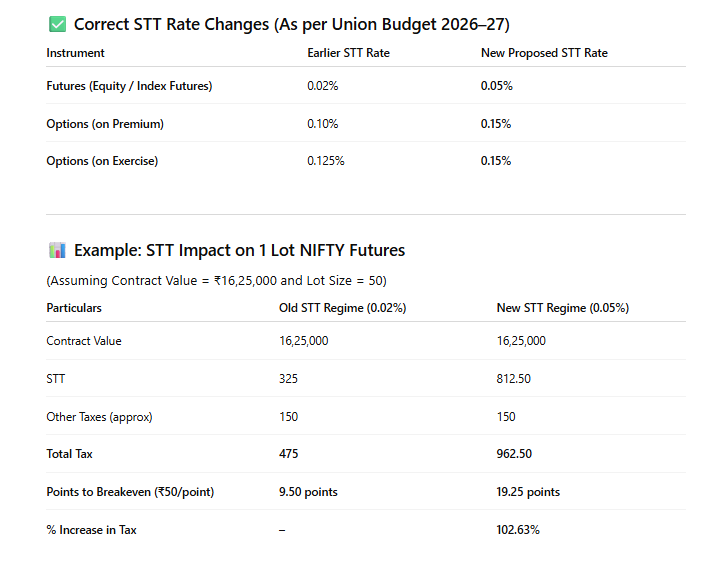
This revision significantly increases the cost of F&O trading and will be felt most by high-frequency and intraday traders who depend on thin margins and frequent trades.
Why Has the Government Increased STT?
The decision to raise STT is driven by two key objectives.
First, it supports higher revenue collection, as derivative trading volumes in India have expanded rapidly over the past few years and now represent a major segment of market activity.
Second, it aims to curb excessive speculation by discouraging rapid churn and short-term trading behaviour that can increase market volatility. By increasing STT, the government seeks to promote more responsible and disciplined participation in the capital markets.
Impact on Futures and Options Traders
For Futures and Options traders, higher STT means increased cost per trade, lower net profit margins and reduced viability of high-frequency trading strategies.
Short-term approaches that rely on small price movements may become less attractive, as a larger portion of gains will now be absorbed by transaction taxes.
Traders may need to adjust their strategies by focusing on higher conviction trades and longer holding periods.
Impact on Long-Term Investors
Long-term investors who primarily invest in equity delivery, mutual funds and ETFs will see minimal impact from the STT hike, as the change mainly targets derivative instruments rather than investment-oriented transactions.
For this category of market participants, the broader investment outlook remains largely unaffected by the increase in STT.
Impact on Option Sellers
Option sellers will experience a direct impact because STT is charged on the premium value. Higher STT reduces net premium income, may lead to wider bid-ask spreads and could result in lower trading volumes in the options segment.
Over time, this may also affect liquidity and pricing efficiency in certain contracts.
STT vs Capital Gains Tax: Key Difference
STT and capital gains tax differ fundamentally in their application. STT is charged on the transaction value and is collected at the time of trade execution, regardless of profit or loss. Capital gains tax, on the other hand, is charged on net profit and is paid at the time of filing income tax returns.
While capital gains tax can be managed through tax planning and exemptions, STT cannot be avoided and remains a fixed cost of trading.
STT Hike as Part of Broader Tax Reforms
The increase in STT is aligned with wider tax reforms announced in the Budget, including the introduction of the Income Tax Act, 2025 effective from 1 April 2026, simplification of tax forms and rules, taxation of share buybacks as capital gains, Minimum Alternate Tax becoming a final tax at a reduced rate, and rationalisation of TCS rates.
Together, these measures indicate a shift towards a simpler, more transparent tax structure with predictable revenue streams.
Conclusion
The hike in STT marks a significant change in India’s capital market taxation framework. While it raises trading costs, especially for derivative traders, it also signals a move toward more stable and disciplined market participation.
For traders, adaptation will be essential as strategies based on high frequency and low margins become less viable. For investors, the long-term story of equity and mutual fund investing remains intact. For students and learners of finance, this reform serves as a practical example of how taxation shapes market behaviour.
Think With Vishal
Finance is not just about markets — it is about understanding the rules that govern them.